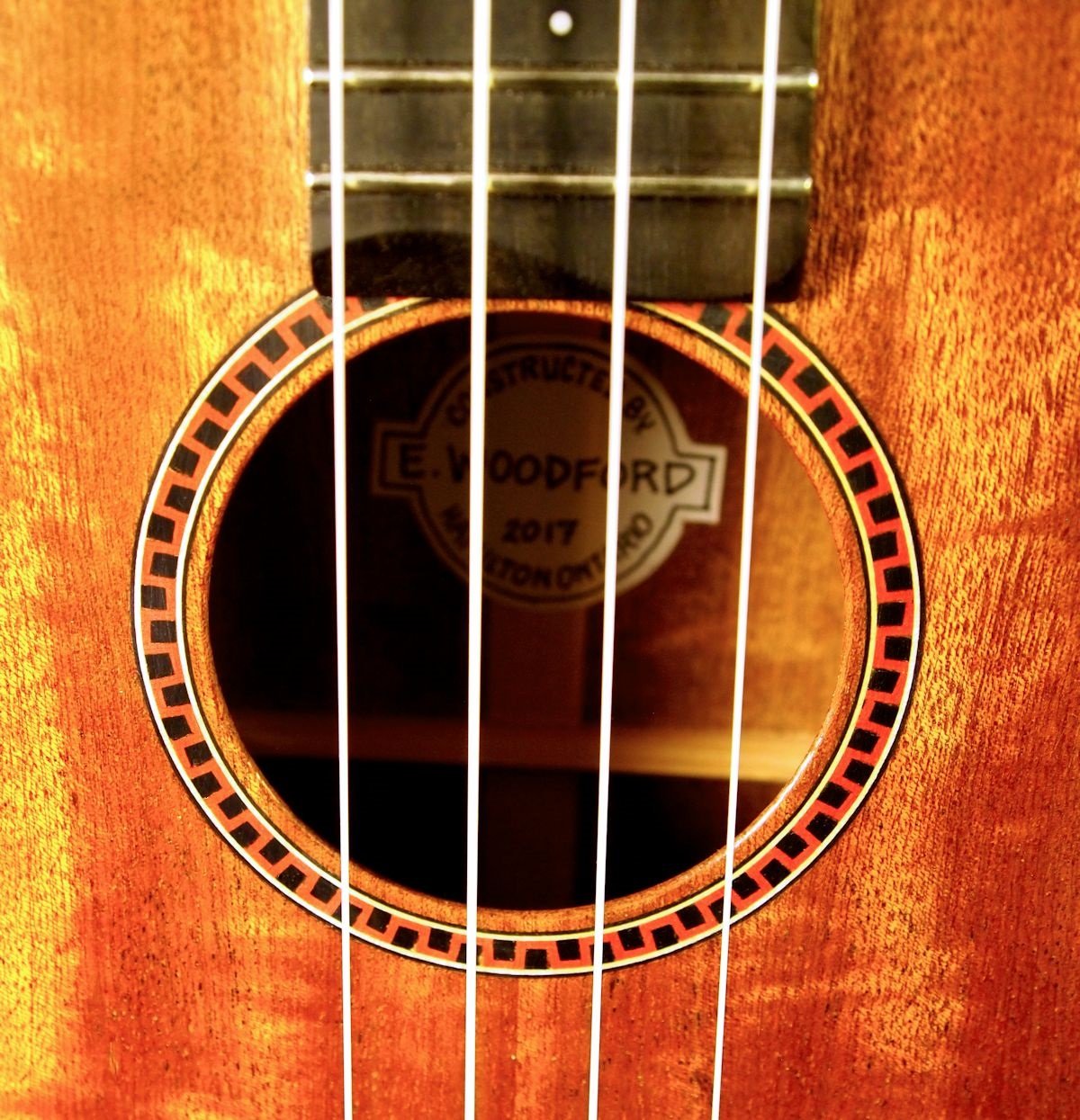
I recently made this ukulele. Sipo body with maple binding, Sapele neck with ebony fretboard, European pearwood bridge (dyed brown), Grover tuning machines, French polished shellac finish over waterbase varnish filler. It's a simple three fan design, and the side depth is about 3/16" narrower than typical. It packs a real punch and I'm very pleased with the way it turned out.
Showing posts with label woodford. Show all posts
Thursday, May 4, 2017
Tuesday, May 2, 2017
Gretsch Guitar Ukulele Repair
April must have been ukulele month. I worked on no less than four of them, in varying sizes, styles and colors. This is an interesting concept - it's a Gretsch G9126 ACE guitar ukulele. It couples the 17" tenor uke scale with the comfort and convenience of six strings (tuned like a guitar capo'd at the 5th fret, A to A.) Neat!
The bridge has been giving me some problems. I noticed it last summer when I did some electronic work, and this time I couldn't let it go without making it better. It uses the slightly archaic system of angled slots cut through diagonally from the top to the back of the bridge:
In this case the slots are augmented with holes intended to receive the knotted ends of string. Only problem is, the slots are a little wide and the holes are a little deep. The knots on the 4th and 5th strings want to creep up inside the slot and once lodged it's a real struggle to get them out.I'm going to inlay a strip of wood along the back edge to eliminate the problem. I see a couple of suspicious looking circles that give me the creeps. I can't be sure of course, but I think there might just be some steel screws hiding in there. I should probably stay away from them with the router bit...
The top on the instrument is not flat. Whether by design or the influence of static forces, it's markedly concave. The braces are all secure though.
For this job I'll use the plywood platform I concocted to let me rout saddle slots in bridges still glued in place on the guitar. This comes in handy for repair work in instances where the saddle isn't compensated correctly. Here it will function as a useful guide. I protect the top of the instrument with padding.
It's clamped to the body with arched beams and cork padding. The 10' radius is tighter than most guitar backs, so the pressure gets applied only on the outside edges where the lining and side offer good support.
The track is a snug fit for my palm router and can be angled or moved back and forth into position. I set the bit for the final depth and pivot it in, taking a series of passes.
There we go: a nice straight-sided cut. I will square up the corners with a chisel.
Planing a piece of rosewood to fit.
Once inlaid and glued, I'm ready to drill the string holes. This operation takes a little courage!
I carefully plotted the required angle by measuring the bridge and figuring out where the drill bit needs to emerge, then planed a little triangular block to act as a drill guide. I apply masking tape to its underside, and also the top of the bridge. Superglue holds the guide in place while I drill.
I protect the top with a piece of thin sheet steel. Holding the 1/16" drill bit in line with the string slot I carefully kept downward pressure on the block. The strings all emerged in a reasonably straight line and in their correct spacing.
All set. Almost. I went back and refined the saddle because it struck me as bulbous and uncouth as furnished by the factory. I can think of more elegant ways to tie the strings on too, but I knew I would likely have to take them off a few times while working on another repair issue (a buzz that took a long time to track down), so I just tied some knots. It works.
These days I seem to be uploading more repair videos on YouTube than writing about them. If you're interested you can find them here: https://www.youtube.com/user/twoodfrd
Saturday, April 25, 2015
Closing the box on a red cedar / East Indian rosewood guitar.
Five fans and a deeply angled diagonal transverse bar are elements picked up from the design of Miguel Rodriguez Jr.
Labels:
classical guitar,
guitar,
hamilton ontario,
luthier,
woodford
Friday, November 7, 2014
A blast from the past.
One of my first steel string guitars has resurfaced and I'm pleased to offer it for sale. It sports serial number 005, and it was made in 2003. It was my third steel string instrument and it has some interesting features.
It's an amalgam of Dreadnought and J-Series design features.
The scale length is 25", the body is 15-3/4" wide.
The nut width is 1-3/4".
The soundboard is Engelmann Spruce.
The back and sides are East Indian Rosewood, as is the fretboard.
The finish is French Polished shellac over polyurethane.
The most unique thing about this guitar is that the neck joins the body at the 13th Fret. Gibson used this most notably on the Nick Lucas Special model, and also some Roy Smeck guitars. When designing this instrument with a "short" 25 inch scale I reasoned that moving the body joint up a fret would keep the bridge back towards the center of the soundboard.
Just as an aside, I'm a big fan of short-scale steel strings. The trend has moved toward 25-1/2"+ lengths in the last decade or so in most of the Asian imports. To my ear they produce a strong fundamental note but it's a little inert. The shorter scale seems to bring out more high partials and. chords sound more interesting. They also have a different feel to them.
The binding is cherry and there's a thin and simple purfling of maple and walnut. There are some wear marks and bruises in the finish, and two cracks (in the finish only), one below the bridge, the other along the bass side of the fretboard. I repaired these eight years ago after the guitar spent some time next to a heating register during the winter months... (Keep your custom guitar in its case and use a soundhole humidifier!!! Grumble.) I think the checks were in the polyurethane I used for the sunburst and it was a little mystifying, because the soundboard itself was undamaged. I put some cleats under the area just to be on the safe side.
The neck is a robust 1950's style C-profile, and the nut is a generous width. The neck was made from very pretty African mahogany. (Wistful sigh. That was a good board... I wish I had more of that mahogany...) The tuners are decent. I can't remember what they were. The neck is attached with a bolt-on arrangement, but also glued in place.
I used hide glue to put the body components together. I'm tempted to reach in there are scrape away the little squeeze-out line next to the back graft. I'm also tempted to start making doodles on my labels again.
The soundhole rings are strips of maple and walnut veneer. The bridge is just a little wider than standard, and the saddle is very tall.
How does it sound? My camera isn't excellent, but I made a little video. I think it's held up well. It's fun to play.
It's an amalgam of Dreadnought and J-Series design features.
The scale length is 25", the body is 15-3/4" wide.
The nut width is 1-3/4".
The soundboard is Engelmann Spruce.
The back and sides are East Indian Rosewood, as is the fretboard.
The finish is French Polished shellac over polyurethane.
The most unique thing about this guitar is that the neck joins the body at the 13th Fret. Gibson used this most notably on the Nick Lucas Special model, and also some Roy Smeck guitars. When designing this instrument with a "short" 25 inch scale I reasoned that moving the body joint up a fret would keep the bridge back towards the center of the soundboard.
Just as an aside, I'm a big fan of short-scale steel strings. The trend has moved toward 25-1/2"+ lengths in the last decade or so in most of the Asian imports. To my ear they produce a strong fundamental note but it's a little inert. The shorter scale seems to bring out more high partials and. chords sound more interesting. They also have a different feel to them.
The binding is cherry and there's a thin and simple purfling of maple and walnut. There are some wear marks and bruises in the finish, and two cracks (in the finish only), one below the bridge, the other along the bass side of the fretboard. I repaired these eight years ago after the guitar spent some time next to a heating register during the winter months... (Keep your custom guitar in its case and use a soundhole humidifier!!! Grumble.) I think the checks were in the polyurethane I used for the sunburst and it was a little mystifying, because the soundboard itself was undamaged. I put some cleats under the area just to be on the safe side.The neck is a robust 1950's style C-profile, and the nut is a generous width. The neck was made from very pretty African mahogany. (Wistful sigh. That was a good board... I wish I had more of that mahogany...) The tuners are decent. I can't remember what they were. The neck is attached with a bolt-on arrangement, but also glued in place.
I used hide glue to put the body components together. I'm tempted to reach in there are scrape away the little squeeze-out line next to the back graft. I'm also tempted to start making doodles on my labels again.
The soundhole rings are strips of maple and walnut veneer. The bridge is just a little wider than standard, and the saddle is very tall.
How does it sound? My camera isn't excellent, but I made a little video. I think it's held up well. It's fun to play.
Labels:
dreadnought,
guitar,
guitar repair,
hamilton ontario,
luthier,
luthiery,
woodford
Subscribe to:
Posts (Atom)